1.shale shaker Working Principle
1. Basic Separation Mechanism
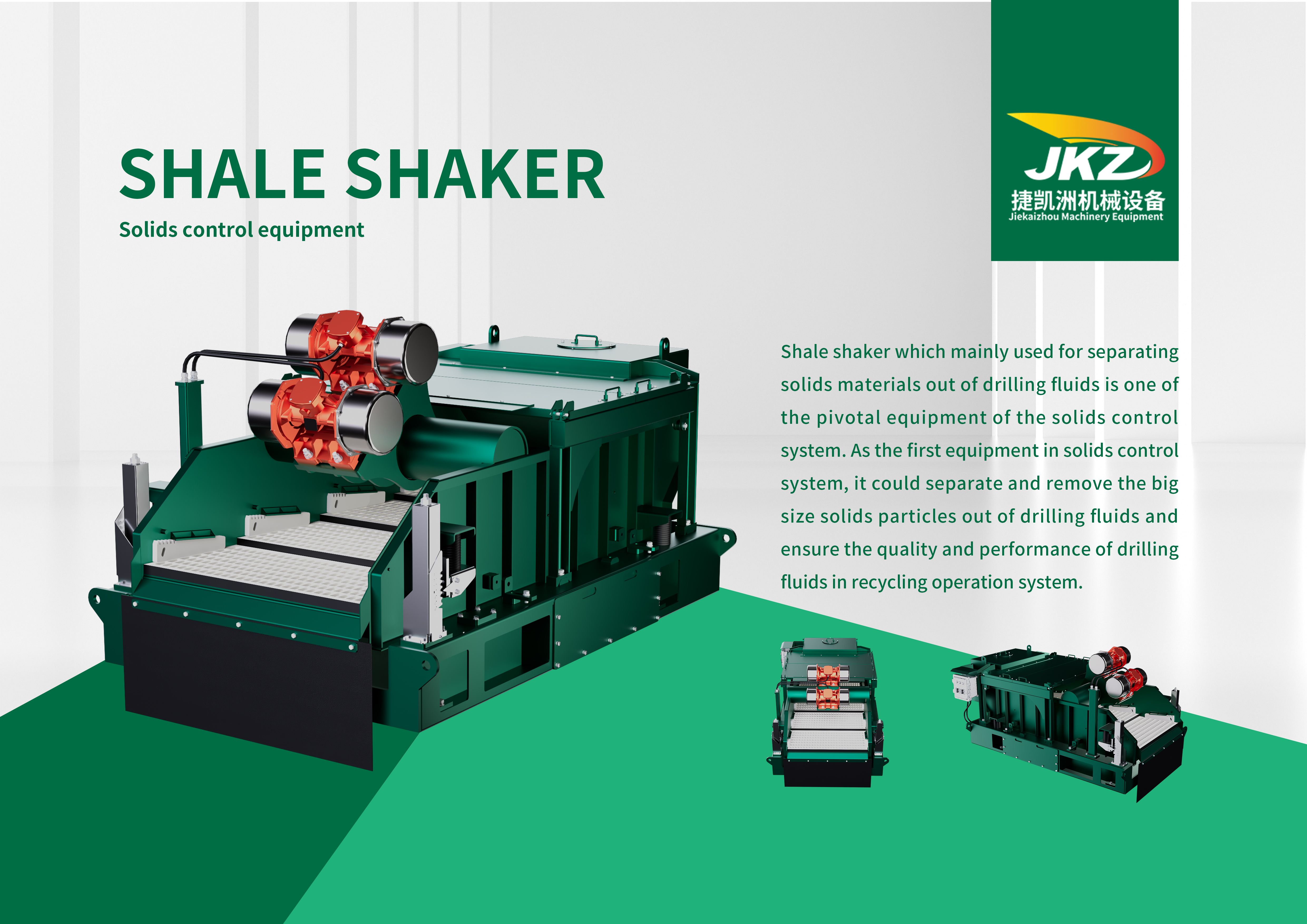
Shaanxi Jiekaizhou Machinery Equipment Co., Ltd. — shale shaker manufacturer China. A shale shaker is essentially a vibrating screening device, and its operation relies on the combined action of "vibration + screening." High-frequency shale shakers for drilling mud: after drilling fluid is introduced onto the screen surface from the wellhead through a feed funnel or mud distribution trough, the screen box drives the screen mesh in reciprocating vibration under the periodic inertial force generated by the vibration motor (exciter). Under the combined action of gravity, vibration inertial force, and screen surface inclination, the liquid phase and solid particles smaller than the screen aperture pass through the screen and fall into the return trough below, flowing into the circulation tank. Particles larger than the screen aperture are retained on the screen surface and, under the vibrating conveyance action, move forward along the screen surface and are finally discharged from the discharge end.
2. Types of Vibration Trajectory
Currently, there are three mainstream vibration trajectories for drilling fluid shale shakers:
Linear motion shale shaker: Two motors rotate synchronously in opposite directions to produce linear vibration, providing stable cuttings conveyance and high processing capacity.
Balanced elliptical motion shale shaker: The elliptical trajectory is consistent at all points, combining the advantages of circular and linear motion, with a processing capacity 20-30% greater than that of a linear shaker.
Negative pressure shale shaker: A negative pressure suction is applied beneath the screen on top of conventional vibration, significantly enhancing liquid removal capability.
3. Key Structural Components
A shale shaker mainly consists of the following components: screen box (including screen frame), vibration motor (exciter), screen mesh, spring isolation system, base, and drilling fluid return trough. Among these, the screen mesh is the core wear part, and its mesh count (aperture) directly determines the separation particle size.
4. Definition of Separation Particle Size
According to the API RP 13C standard, modern shale shaker screens are identified by API number and D100 cut point, replacing the traditional concept of "mesh count." For example, an API 200 screen has a D100 value of approximately 74-75 μm, meaning it can effectively separate solid particles larger than this particle size. In field use, conventional shale shakers can typically go as fine as 120-200 mesh, corresponding to a separation particle size of approximately 74-125 μm.
5. Factors Affecting Processing Capacity
The processing capacity of a shale shaker (usually measured in L/s) is affected by multiple factors: vibration intensity (amplitude and frequency), screen area and aperture, screen surface inclination, drilling fluid rheological properties, and solid content and particle size distribution. Generally, the processing capacity is required to be ≥ 50 L/s, with a separation particle size covering particles above 75 μm.
2. Application Scenarios
1. Position in the Solids Control System
The shale shaker is the first stage and the most important equipment in the drilling fluid solids control system. SLB's oilfield glossary explicitly states that the shale shaker is "the primary and possibly most important equipment on the rig for removing drill cuttings from the mud." Its upstream directly receives the cuttings-laden drilling fluid returning from the wellhead, and its downstream is sequentially connected to the degasser, desander, desilter, and centrifuge.
2. Applicable Working Conditions
The application of shale shakers runs through the entire drilling operation and is suitable for:
Water-based drilling fluid: Conventional treatment, where the shale shaker is the main equipment for cuttings removal.
Oil-based drilling fluid: Higher requirements for cuttings liquid content. The liquid content (by volume) of cuttings discharged by conventional shale shakers can reach 37.8% or more, requiring negative pressure shale shakers or subsequent centrifuges for volume reduction treatment.
High-viscosity mud or clay-making formations: Prone to "screen blinding" (near-size particles blocking screen apertures), requiring negative pressure unblocking or water mist spraying to assist conveyance.
Offshore drilling platforms and land rigs: For occasions with high requirements for footprint and environmental emissions, negative pressure shale shakers are more advantageous due to their ability to significantly reduce cuttings liquid content.
3. Impact on Downstream Equipment
The operating status of the shale shaker directly affects downstream equipment: if the screen mesh is damaged or bypass operation occurs, a large amount of drill cuttings will enter the circulation tank, causing cyclone blockage, which in turn leads to accumulation of drill cuttings concentration in the drilling fluid, and in severe cases affects drilling safety and efficiency. Therefore, the normal operation of the shale shaker is the prerequisite for the effective operation of the entire solids control system.
3. Usage Methods
1. Pre-Start Inspection
Screen mesh status: Check whether the screen mesh is tensioned, damaged, or correctly installed. Improper tension can lead to early screen failure or mud bypass.
Vibration motor and springs: Confirm that the motor and guard bolts are complete and tightened, and that the vibration springs or rubber blocks are not broken or detached.
Lubrication and transmission: Check the grease status of the eccentric shaft, and rotate the belt 2-3 turns to confirm normal rotation.
Seals and piping: Confirm that the feed pipeline connection is reliable with no leakage points.
2. Operating Parameter Settings
Amplitude: Adjust according to drilling fluid density and working conditions. When the density is high (e.g., >1.8 g/cm³), the amplitude should be adjusted to 4-6 mm; when treating low-density mud, 3-4 mm is more appropriate.
Screen mesh selection principle: Under the premise of not losing whole mud, select the finest screen mesh possible. Finer screens remove more solids, but the processing capacity per unit area decreases accordingly. Modern high-efficiency rigs are often equipped with 4 or more shale shakers to obtain sufficient processing area under fine mesh conditions.
Screen surface coverage: During normal operation, the drilling fluid should cover at least 75%-80% of the screen surface area to fully utilize the screening capacity. If it covers only 1/4 to 1/3, it indicates that the screen mesh is too coarse.
3. Operating Key Points
Continuous operation: During circulation, the shale shaker should run continuously; stopping means drill cuttings are no longer being removed.
No bypassing: It is strictly prohibited to bypass the shale shaker or operate with damaged screens, which is the main cause of downstream cyclone blockage.
Timing for screen replacement: Whenever possible, replace screens during connections (when adding a drill pipe) to reduce the impact of screen downtime on solids control effectiveness. Before replacement, prepare tools and screens, and request assistance if necessary.
Clay formation assistance: When handling sticky cuttings, water mist spraying (mist only, not high-pressure washing) can be used to assist conveyance, but it is not recommended for weighted drilling fluids or oil-based drilling fluids.
4. Maintenance
Screen inspection frequency: Check tension 1 hour, 3 hours, and 8 hours after installation, and then once every hour thereafter. Frequently check for damage, and immediately repair or replace any holes found.
Lubrication interval: Vibration motor bearings are typically replenished with grease every 1500-2500 hours.
Wear part replacement: Regularly inspect isolation elements and screen support rubber, and replace them promptly when signs of aging or wear appear.
Shutdown cleaning: Clean the screen promptly after tripping out or shutting down the shaker to prevent mud from drying and clogging the screen apertures.
Electrical equipment protection: Do not splash water or oil onto motors and electrical equipment during cleaning.
5. Safety Guidelines
Strictly prohibited to operate power switches with wet hands, and strictly prohibited to perform maintenance during operation.
Do not stand on the screen surface or place heavy objects on it, and do not use a shovel to scrape mud and sand.
Electrical maintenance must be performed with complete power disconnection, and maintenance operations must follow lockout/tagout procedures.
Learn More Shaanxi Jiekaizhou Machinery Equipment Co., Ltd. Address: No. 2, West Section, Xiushu Road, Bawanghe Industrial Park, Jinqu Town, Meixian County, Baoji City, Shaanxi Province, China Tel: 86-29-81120800 Mobile: +86 17795769978 Email: derek@jkzsolidscontrol.com